
How to cook in a small kitchen with limited counter space
Last updated By Maya Bennett
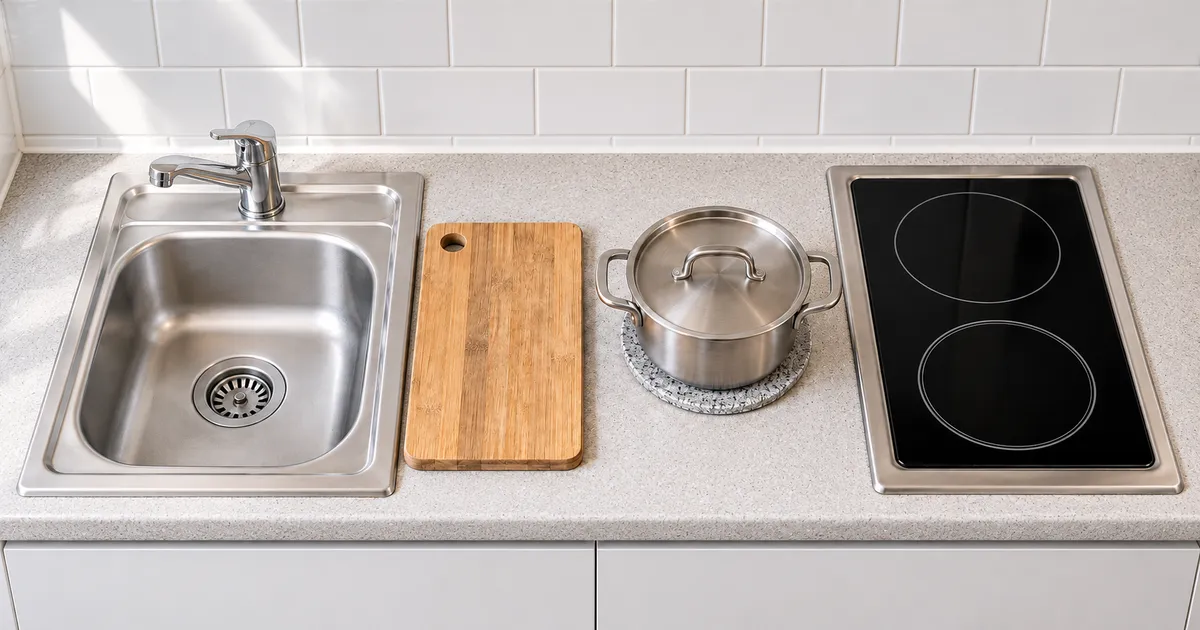
A crowded counter often means the next task has nowhere safe to land: the pan is ready, the board is dirty, and plating has to wait. Trace one familiar meal from cold storage to the sink, measure the pinch point with doors and drawers open, then move one item or temporary surface before buying anything. This method is for solo cooks in U.S. apartments, studios, and galley kitchens; mobile kitchens have different fuel, water, ventilation, mounting, and local constraints.
Key takeaways
- Trace one recurring meal from cold storage to cleanup and mark the first handoff that blocks the next task.
- Measure usable surfaces and paths with doors, drawers, faucets, and appliances in their working positions.
- Assign safe landing places before adding a board or cart; test its fit, stability, storage, and effect on the walkway.
- Use the exact appliance manual and keep raw-food tools and surfaces separate from ready-to-eat food.
Map the handoffs in one meal
Follow a familiar meal from cold storage through prep, heat, plating, and cleanup. At each stop, jot down what arrives, where it waits, and what needs that spot next. Mark the first backtrack, blocked door, or pause because a tool has nowhere to go. That is the problem to solve first.
For a skillet dinner, the board and knife need prep space; the pan and lid need safe places near the heat; the finished plate needs a clean landing; and the dirty board needs a route to the sink. If the lid takes the only clear patch, mark that spot before you rearrange the spice drawer.
Measure the kitchen with doors open
Measure the room in working position: open the refrigerator, drawers, and cabinets; move the faucet handle through its range; and include appliance doors and cords. Measure usable width and depth at each possible landing, then trace the route between cold storage, prep, heat, and sink. Nominal counter length can hide a corner that an open drawer makes unusable.
| Measure | Decision it changes |
|---|---|
| Clear counter width and depth | Whether a board, pan, or plate fits without covering the next task |
| Door, drawer, and faucet movement | Whether the landing stays accessible during the meal |
| Appliance footprint and cord path | Whether the unit and its connection fit that spot |
| Route between work points | Whether a cart, stool, or open drawer narrows the path |
Write down the one clearance or surface dimension that rules a placement in or out. A measurement matters because of the door, faucet, or shape beside it; there is no single counter dimension that settles every kitchen. If you need a room-layout example after measuring, the 6-Foot Galley Cooking Triangle is a useful next read.
Give hot cookware, dirty tools, and plates separate landings
Assign each pause point by what will land there. Put hot cookware on a heat-suitable surface or trivet allowed by the appliance instructions. Leave a clear route from a dirty board to the sink. Reserve a stable clean spot for the finished plate, outside active heat and raw-food prep. These jobs can share a counter at different times; decide where the next item goes before the current one fills the space.
| What is waiting | Landing rule |
|---|---|
| Hot pan or lid | Use a heat-suitable surface permitted by the appliance instructions |
| Dirty board or utensil | Keep a route to the sink, apart from the clean prep spot |
| Finished plate | Reserve a stable place outside active heat and the raw-food path |
Keep towels, paper, packaging, wooden utensils, and curtains away from the stovetop. The National Fire Protection Association advises staying in the kitchen while frying, boiling, grilling, or broiling, and keeping combustible items away from the stovetop.
Add a temporary surface only if it fixes the measured gap
An over-sink board helps only if it fits the actual sink and sits securely. Measure the opening and ledges, check the faucet and handle clearance and how the board is supported, then decide where it can be stored cleanly. Its use and storage spot both need to leave the walkway open.
For a movable board or cart, mark its footprint in the meal path and open nearby doors and drawers. Try it at the handoff you identified. The bottleneck remains if it wobbles, blocks a route, or has no clean storage home. Keep the trial reversible until the extra landing proves useful.
Move storage out of the active path
Sort one drawer or cabinet around the meal you mapped. Keep tools that support it within a safe, comfortable reach; relocate occasional items; and remove duplicates with no clear task. Move one thing, then run the route again. Judge the move by whether the next handoff now has room.
Check that the new spot leaves doors, appliance airflow, heat areas, and landings usable. Keep the surrounding surface accessible for cleaning.
Let the exact appliance manual govern its counter spot
Before moving or buying an appliance, identify its exact model and find its manual and nameplate. Compare the footprint and measured location with the manual's requirements for clearance, heat, airflow, and use surface. Read the nameplate for voltage and wattage, and note what else may run on the same circuit. Use the exact model's measurements to decide whether this spot works.
Keep vents clear and the top or surrounding area open wherever the instructions require it. Include cleaning access and a storage place in the footprint, too. If the manual, nameplate, or existing circuit leaves a building question unresolved, pause and ask property management or a qualified professional. Do not solve a placement problem by improvising electrical changes.
Keep raw-food cleanup on its own path
Use a separate board or plate for raw food and keep it apart from ready-to-eat food. After handling raw food, move it away, wash your hands with warm, soapy water, then wash the board, utensils, dishes, and counter with hot, soapy water. Do not rinse meat, poultry, fish, or eggs in the sink; splashes can spread bacteria. The FDA's home food-safety guidance covers separating raw foods, handwashing, washing food-contact surfaces, and avoiding rinsing those foods.
Keep the clean serving spot free while the raw-food tools wait for washing. Once the board and work surface are clean, use that landing for ready-to-eat food. Keep the dirty route at the sink and the plate's route clear.
Test one reversible change with the same meal
Repeat the same meal and route after changing one thing, such as moving an item or trying a temporary surface. Compare the same blocked handoff you noted at the start.
| Check | Before | After | Decision |
|---|---|---|---|
| Meal and route | Note the meal from cold storage to sink | Repeat the same meal and route | Keep the comparison consistent |
| Target problem | Record the blocked landing, backtrack, or door conflict | Check whether that same problem remains | Keep, move, or remove the change |
| Access and safety | Note relevant manual, heat, walkway, and cleanup constraints | Check those same constraints again | Undo the change if access is blocked or instructions are compromised |
Keep the change only if it clears the handoff and leaves the walkway, appliance instructions, and cleanup path workable. If the original blockage remains, move the item back and test one different change.
Related product reviews

Best Collapsible Cookware for Small Space Living
Compare top collapsible and nesting cookware to save kitchen space, streamline cooking, and pick heat-safe, lightweight sets ideal for small space living.
Read more
Best Cabinet-Door Lid and Cutting Board Holders for Small Spaces
Maximize small space kitchen storage by mounting lid and cutting board holders on cabinet doors, free counters, organize items, and access essentials fast.
Read more
Best Magnetic Fridge-Door Spice Racks for Small Space Kitchens
Find magnetic fridge-door spice racks to free up counters, keep spices within reach, and boost storage for cooking in tiny kitchens and small space living.
Read more