
Best Over-Cabinet Drying Racks for Kitchens, RVs & Camper Vans
Last updated By Maya Bennett How we chooseAffiliate disclosure
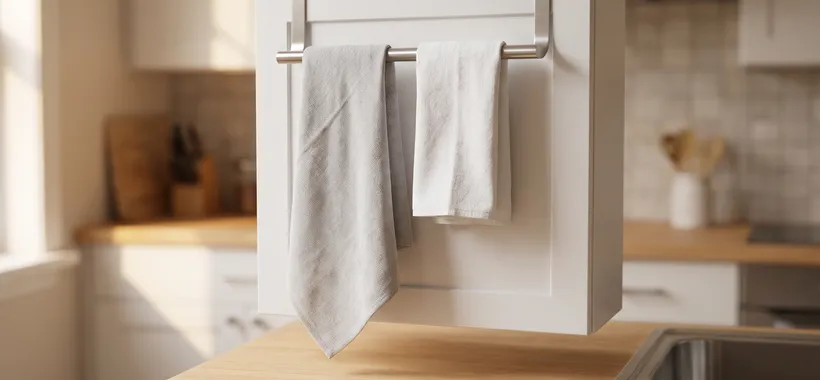
The honest answer comes first. An over-cabinet or over-the-door drying rack is the right tool for towels, dish cloths, garments, delicates and herbs, and the wrong tool for a full load of dishes. It hangs on vertical space the room already has, installs without tools, and costs the counter nothing. What it cannot do is carry a dinner's worth of plates. Everything hung over a door puts its weight on the door's top edge, and the door hands that weight to its hinges. Light, quick-drying items belong up there. A real dish load belongs laid across the sink or standing on the counter.
That splits the shopping into three routes. If the job is towels and cloths at a particular cabinet door, measure that door's thickness, trim included. If the job is laundry and hand-washables, measure a door's width and check what its swing runs into. If the job is dishes, measure the sink opening or the strip of counter you can spare. The lineup below covers all three routes, and every pick carries the one measurement that rules it in or out.

KES KTH200S26 Over-Cabinet Towel Rack, 2 Pack, Brushed Stainless Steel

Greenco 3-Tier Over-The-Door Folding Drying Rack, Black

Yamazaki Home 7161 Over-The-Door Hooks, Folding Hanging Coat Rack

Kraus 20.5 in Over-Sink Roll-Up Dish Drying Rack, Jet Black

Ohuhu Over-Sink Roll-Up Dish Drying Rack, Silicone Wrapped, 17.6 x 15.4 in

Kohler K-5473 Over-The-Sink Drying Rack Caddy with Towel Bar, Charcoal

simplehuman Compact Dish Drying Rack with Swivel Spout, Grey
The lineup at a glance
Every row pairs a real product fact with the one measurement that settles it, and the last column is where each pick goes when it is not working.
| Rack | Mounts on | Dries best | The measurement that decides | Where it lives after |
|---|---|---|---|---|
| KES Over-Cabinet Towel Rack | Over a cabinet door | Hand towels and dish cloths | Door thickness including trim: fits doors under 1 in | Lifts off the door, two per pack |
| Greenco 3-Tier Over-the-Door Drying Rack | Over a door | Sweaters, delicates, hand-washables | Door width and height with swing room: 26.5 W x 18 D x 34.5 H in deployed | Folds flat against the door |
| Yamazaki Over-Door Hook Rack | Over a door | One towel or jacket | Door thickness up to 1.375 in, plus 0.625 in closing clearance | Folds up out of the way |
| Kraus Over-Sink Roll-Up Dish Drying Rack | Across the sink | Full dish loads and produce rinses | Sink opening vs the 20.5 x 12.75 in span | Rolls into a drawer |
| Ohuhu Silicone Roll-Up Dish Drying Rack | Across the sink | Dish loads on smaller sinks | The sink's short side: 17 in or less (rack is 17.6 x 15.4 in) | Rolls into a drawer |
| Kohler Over-the-Sink Drying Caddy | Over the sink | Utensils, mugs, dish cloth | Sink span between 14.6 and 17.6 in | Stays mounted |
| simplehuman Compact Dish Rack | On the counter | A real dish load with no measuring | About 15 x 15.5 in of counter within spout reach | Lives on the counter |
KES Over-Cabinet Towel Rack, 2 Pack: towels off the counter, no tools
This is the default pick for the job the title names: hand towels and dish cloths off the counter, hung at the cabinet door where they get used, with no tools and no holes. The hooks fit cabinet doors under 1 inch thick. That single measurement rules the pick in or out, so take it first, with trim and any raised panel included, not the bare door edge.
Measure before ordering, not after the box is open.
Installation is hanging it over the door. EVA foam pads stick inside the hooks so the metal never touches the finish, and moving out means lifting the rack off, leaving the door as it was found. The hooks are 1.45 inches long and laser-welded, and they hold the 10.39 inch curved crossbar 1.3 inches clear of the door face. That clearance is not a styling detail. A towel hung flat against a cabinet panel dries slowly and can leave the panel damp underneath. Hung here, air moves around both sides of the towel and the panel behind it stays dry.
The bar is rated to carry 11 pounds. Plan for dish towels and hand towels, not a wet hand-wash load.
It comes as a 2-pack, which matches how kitchens use towels anyway. One bar on the cabinet next to the sink for the dish towel, one on the door by the stove for hand towels, or the second one rides in the RV's drawer until it is needed. The bar itself is 18/8 Type 304 stainless steel with a brushed finish, a material chosen to resist rust in daily kitchen use, which matters most in a humid kitchen or a van.
The trade is the fit boundary, and it is real. A door that measures an inch or more including trim is out, and no pad negotiates that away. Skip it, too, if a hanging towel would block a latch or an appliance handle, because a towel that clips the dishwasher is a towel you will quietly stop hanging. If the door runs thicker than an inch, the Yamazaki hook below takes doors up to 1.375 inches and handles the same job in miniature.
Greenco 3-Tier Over-the-Door Drying Rack: laundry day off the floor
When the drying job is a sweater that cannot go near a dryer, this is the pick. Three tiers of mesh hang on the back of a door and give a hand-washed load more drying room than anything else here. Deployed, the rack spans 26.5 inches wide, 18 inches deep and 34.5 inches tall. Check those numbers against the door itself, its width, the height below the top edge, and what the loaded tiers will meet when the door swings open. A closet door that opens onto a packed closet fails this test even when every number looks fine.
Between laundry days the whole thing folds flat against the door, or unhooks entirely, so the drying station exists only when laundry does. The hooks are solid metal and hang over the top of the door with no nails, which makes it as reversible as a towel bar and kinder to a deposit than anything screwed in.
The tiers are breathable polyester mesh, and the material matters as much as the size. A sweater laid flat on solid plastic traps dampness against the fabric. On mesh, air moves through the knit from both sides, which is the whole reason flat drying works.
Keep its job honest, though. These are garment tiers, sized for clothing and sweaters, and they are not built for a dinner load of plates. Skip it for dishes, and skip it if the door is unusually short or the open mesh would crowd a closet's interior. If the job is one or two towels rather than a laundry day, the KES bar above is the lighter answer.
Yamazaki Over-Door Folding Hook Rack: one spot, then out of sight
Sometimes the whole job is one towel that has nowhere to hang. This folding hook is the narrowest answer in the lineup, a powder-coated stainless hook that hangs over the door's top edge, takes a hand towel or tomorrow's jacket, and folds up against the door when it is not needed. Two measurements settle it. The door can be up to 1.375 inches thick, and thinner RV and closet doors usually sit well under that limit. There also needs to be about 0.625 inches of space above the door so it can still close with the rack on.
The hook is rated to carry 13.2 pounds. Treat it as one light item at a time, a towel, a robe, a jacket. It is a hook, not a drying surface, and a second towel needs a second hook or a different product. Two towels on two doors is the KES bar's job, not this one's.
When the towel is dry or company is coming, the hook folds up and the doorway looks untouched. That is most of its value, and the value is what it does not take up. If the door fails the clearance check, wall-mounting hardware comes included, so the same hook can go on the wall beside the door instead, at the usual cost of drilling. Skip it if the door is thicker than 1.375 inches, lacks the closing clearance, or if the job is really a laundry day rather than one item.
Kraus Over-Sink Roll-Up Dish Drying Rack: full dish loads, straight into the sink
For readers whose real job is dishes, this is where the lineup changes categories, and this Kraus grid is the anchor. It is a stainless steel mat, 20.5 by 12.75 inches laid open, that rests across the sink basin and turns the sink itself into the drying rack. Measure the sink opening against that span before anything else. A sink close to 20.5 inches gets a rack sitting on both edges. A sink well under it gets edges hanging in the air doing nothing, which is the same as no rack.
Because it is an open grid, the water goes where the water already goes. There is no tray to pull out and empty, no drip mat to rinse and then stand somewhere else drying. Kraus describes the design as eliminating pools of water, and the mechanism is simple enough to picture: every drop falls through into the basin.
Storage is the other half of the story. The grid rolls up into a 2.4 pound roll with a 0.38 inch profile, so it lives in a drawer between meals or stays on the sink all day, and nothing needs assembling. In a small kitchen the drying rack's permanent footprint is usually the main objection. A drying station that turns into a rolled-up mat in a drawer changes that math.
The same square footage covers prep, not just dishes. Rinse produce straight over the sink, or let just-washed greens drain on the grid while the pan soaks below it.
The trade is that the fit is exact. The span does not adjust. If the opening measures well under 20.5 inches, the Ohuhu roll-up below covers smaller sinks.
Ohuhu Silicone Roll-Up Dish Drying Rack: the smaller-sink span
This is the roll-up for the sink the Kraus span misses. Its rule is concrete: it fits sinks whose shorter side does not exceed 17 inches, and this option measures 17.6 by 15.4 inches. Measure the short side of the basin, not the one you hope is shorter. One more rule excludes a whole sink style outright. A sink with one uneven, farmhouse-style side will not seat this rack, whatever the tape says, because the silicone edge cannot rest evenly on it.
The silicone is the reason this entry exists next to the Kraus grid. It wraps steel tubes, so the rack grips the rim instead of sliding on it, and dishes grip the rack instead of skating on bare steel. Glasses settle where you put them, a cutting board stays put, and water still drains between the bars into the basin.
Ohuhu's line offers five sizes. This is the 17.6 by 15.4 inch Gray option, and the other sizes are not reviewed here. If the short side runs larger than 17 inches, the size ladder, not this entry, is the place to look, and the Kraus anchor covers spans near 20.5 inches. In a one-counter kitchen the flat surface earns a second job: a cutting board can sit across it and the rack becomes a prep ledge over the sink.
The ceiling is the trade. Care is a rag wipe and a roll back into the drawer, which is about as low as upkeep gets.
Kohler Over-the-Sink Drying Caddy: utensils, mugs and the dish cloth, corralled
Not every daily wash is a dinner load. If it is a few utensils, a couple of mugs and a dish cloth, this Kohler caddy holds all of it over the basin in one structure that never gets put away. It expands 3 inches to grip sinks from 14.6 to 17.6 inches across, the smallest span any over-sink pick here handles, which is the point for the narrow sink a 20.5 inch grid cannot sit on.
The structure is the difference from a flat surface. A removable soaking cup holds utensils and scrubbers, and lifts out to fill, empty or wash. A rail along the front is the dish cloth's spot, so the cloth drips over the sink instead of folded on the counter it just wiped. Mugs dry upside down over the basin, so the coffee routine's water falls where the water goes instead of pooling on the counter.
Depth is the honest limit. At 5 inches deep, the caddy is a rail-and-cup station, not a landing pad, and plates do not lie flat here. A plate stack or a dinner load needs more flat area than this caddy holds. Stay inside the 14.6 to 17.6 inch span, and if the sink fits it but the job is flat drying area rather than structure, the Ohuhu roll-up covers the same span with a mat instead of a cup.
simplehuman Compact Dish Rack: when nothing in the room fits
There is a reader every measurement in this article has turned away: doors too thick, sink span matching nothing, drilling not an option. This is that reader's pick. The simplehuman compact dish rack stands on the counter and takes a real dish load with no door, sink or rim involved in the decision. The cost is permanent rent. About 15 by 15.5 inches of counter, every day, plus the reach the spout needs toward the sink edge.
Placement stays flexible because the drainage aims. A 360 degree swivel spout directs water into the sink from wherever the counter allows the rack to sit, so the rack adapts to the counter instead of the counter dictating the rack. simplehuman says the tray under the rack spreads water thin so it dries without puddles. The part that holds regardless is simpler: the pieces come apart, so a rinse resets the rack when it needs one.
Ownership is placement and rinsing, not installation. Unpack it, set it down on its anti-slip rubber feet, done. Silicone-capped wires hold plates upright without scratching them, and the stainless frame cleans up with a wipe. Skip it if the counter is already spoken for, because a rack that never leaves has to earn its square footage daily. If a 14.6 to 17.6 inch sink exists somewhere in the kitchen, the Kohler caddy above pays much less rent for a small daily wash.
Measure first: the fit routine that settles every pick
Every section above named its one measurement. This is the full rehearsal, about five minutes, that rules every pick in or out in your own room before money moves.
Start with the door, including the trim
The door-hung picks gave their numbers: under 1 inch for the KES bar, 1.375 inches for the Yamazaki hook. Both are measured at the door itself, trim and raised panels included, not the bare edge. A door that passes bare can fail once the raised panel is part of the measurement, so put the tape where the hardware will actually hang. Then check the closing side. Hooks and folding racks need a little clearance between the door's top and the frame above it for the door to still shut, and that gap is easy to miss until the rack is on and the door will not close.
Then the sink span
The over-sink picks carry three different contracts. The Kraus grid needs an opening near its 20.5 inch span. The Ohuhu rack asks for a shorter side of 17 inches or less and refuses sinks with one uneven side. The Kohler caddy expands to cover 14.6 to 17.6 inches. Measure the opening, then look up. A faucet or a sink ledge that blocks a flat lay vetoes a roll-up no matter what the tape said.
Rehearse the fit in motion
A static measurement catches only part of the fit, and I learned the difference the way most people do, with a towel bar that blocked the drawer beneath it every time the door swung. Tape or cardboard the footprint where the rack will live, then run the routine. Hang a wet towel on it, open the door all the way, close it, and take the towel off again. Carry the largest thing that normally travels that path, a stack of plates, a laundry basket, a grocery bag, and notice what clips. Mark the tightest point, because that point controls the purchase. Once a rack is in hand, work it empty through its full range, fold, swing, slide, before anything fragile goes on it. Adjusting a setup is easy while it holds nothing.
Match the load to the mount
Load a door-hung rack like a counter and the door levers, sags, or stops closing flush.
That is the physics behind the rule this whole article runs on: light, quick-drying items belong on doors, and dish loads belong over the sink or on the counter.
After the first loaded day, watch the door. If it sags, scrapes the frame or will not close, move the load somewhere else. Follow the installation instructions for the exact model, and stop if the door or cabinet cannot accept that method. Never improvise fastening into wiring, plumbing, glass, tile or an unknown hollow panel to force a marginal fit to work.
Airflow and where the water goes
Where the water goes decides whether a drying rack saves work or just moves it. The over-sink grids drain into the basin. The countertop rack collects in its tray and aims the water at the sink with its spout. The door-hung picks have no drain at all, so they need moving air. Fabric pressed flat against a panel holds its own moisture, and damp fabric left that way goes musty before it dries. Crack the door while things dry, prefer open mesh and wire to solid surfaces, and wipe the contact pads now and then so damp has nowhere to settle.
Materials for humid rooms
In a humid kitchen or a van, the finish is part of the buying decision. Stainless steel, silicone and powder-coated steel are the corrosion-resistant choices in this lineup, chosen to resist rust in daily use rather than to survive neglect forever. Wipe the metal down when you clean and let it dry, and the finish does the job it was chosen for.
The RV and camper-van checks
If the room rolls, add four checks the apartment reader can skip. RV cabinet doors are often thinner and lighter than house doors, with curved or lipped trim, so measure at the latch side, not just the hinge side. Check whether the latch itself collides with hook hardware when the door closes. Plan to lift hook-mounted racks off or stow them on travel days, because road movement is unkind to anything perched on a door. And treat the humidity advice above as mandatory rather than optional, since wet towels and small interiors share a lot of air. Every check here is yours to run in your own rig.
When nothing fits
The last route costs nothing. A dish towel dries over the oven handle or on a hook the kitchen already has. A sweater dries on a hanger from the shower rod. A freestanding rack earns its floor space only if a corner is genuinely free, and the rehearsal above will tell you that in one pass. If a rack in this article failed its rehearsal in your room, the honest move is to not buy it. The right rack survives the five minutes. The wrong one does not, and that is the whole test.
Guides that use these ideas

Off-Grid Tiny Home Maintenance: Your Seasonal Checklist
Stay powered and prepared year-round. Get seasonal checklists for solar, water, heating, and emergency prep to prevent costly off-grid system failures.
Read more
Tiny Kitchen Plumbing: Layouts That Boost Workflow & Access
Learn how to reconfigure sink, drain, and water lines in your tiny kitchen for smoother workflow and easier access, plus layouts, code tips, and DIY options.
Read more
Warm, Dry Floors: Underfloor Insulation for Raised Tiny Homes
Keep floors warm and mold-free in raised tiny homes. Pick the right underfloor insulation, plan ventilation, and seal out moisture for lasting comfort.
Read more