
Can a Couple Live in a Studio Apartment? How to Make One Room Work (and When It Stops)
Published By Maya Bennett
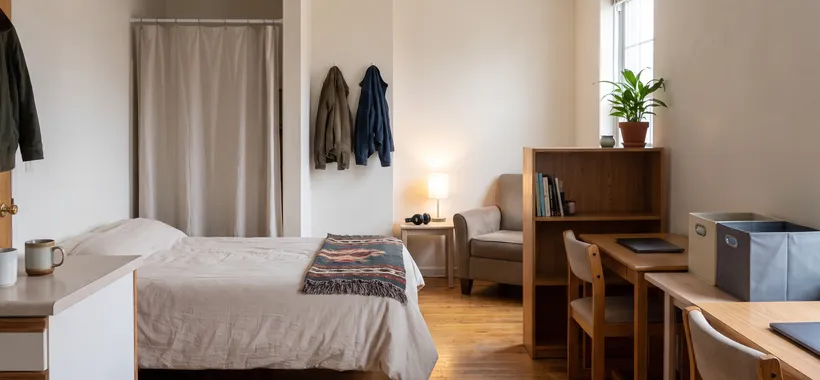
Yes. Couples share studio apartments all the time, and the ones who make it work are not the ones with the biggest floor plan. They are the ones who arranged a few things instead of hoping: the room is zoned around what it forces, storage is split on purpose, and the boundaries nobody should have to assume get said out loud. This guide plans each of those pieces for your own studio, then works through the fork between fixable friction and the conclusion that the fit itself needs more rooms.
The short answer
Yes, a couple can live in a studio apartment, but only as a deliberate arrangement. It works when the zoning respects what the room forces, when storage is split on purpose, and when quiet hours, alone time and guest rules are said out loud instead of assumed. Where those pieces are in place and the friction returns anyway, the guide gives the diagnostic test for telling a fixable friction problem from a fit that needs more rooms, and what each answer would mean to do next.
What does sharing one room actually ask of two people?
Every studio hands its residents two kinds of conditions, and confusing them is how couples end up arguing about the wrong thing.
The physical half belongs to the room, and it starts with the bed, which usually owns the largest rectangle of floor in a studio and asks for a usable path along two of its sides, not just the one you walk most. If the closet is the single one, it comes halved by default. If the kitchen shares the room, cooking noise and smell reach every corner. If the window is the only one, its light belongs to both of you until a divider spends it. The one door swings where it swings, and it greets visitors before either of you does.
The behavioral half is agreement-shaped: standards of neatness, expectations of undivided attention, schedules, and how much background noise still counts as background. Agreements move this half. Nothing said out loud will shrink a bed.
The sorting rule is what the split is for. When a problem keeps returning, ask which half it lives in before reaching for a tool. No amount of talking fixes a bed that eats the walkway, and no divider fixes a fight about the dishes. Naming the problem as the room's or the couple's decides which fix gets tried first, and it saves the next three arguments from being filed under the wrong subject.
How do you zone a studio so two people both get a corner?
Zone in the order the room forces, not the order a catalog suggests. The immovable jobs claim lanes first: the bed with the two paths it needs, the cooking route if the kitchen shares the room, the bathroom route that gets walked in the dark, and the swing of the single door. What is left over becomes the budget.
Walk the lanes before buying anything to fill them. The bathroom path at 2 a.m. is not the same path the morning routine uses, and a desk chair whose swing ends inside the bed's lane announces itself the first morning it happens. If the arrangement is still hypothetical, tape the lanes on the floor and live beside them for a day.
The corners that survive get spent deliberately. The corner the door does not open into is the natural private corner, because guests and most interruptions arrive through that opening. The corner with the only window goes to whoever needs daylight to read, work or wake up. Giving it to one person costs the other one daylight, and that trade is worth stating plainly: from then on the light tends to arrive on their side of the room first.
Only when the corners are assigned does a separator get chosen.
Which separator earns its footprint?
Each option buys privacy by paying for it with something the room was already using.
| Separator | What it asks of the room in use | Renter reversibility | Best when |
|---|---|---|---|
| Open bookshelf | The walkway narrows at its stand, and the shelf competes with dishes and jackets for its depth | Freestanding, no wall marks | One of you wants display storage and a soft visual break more than a solid block |
| Curtain | The light gets swallowed on the side it covers, and drawing it across becomes a daily ritual at the boundary | Highest of the group. A tension rod touches no wall. A drilled rod is a permission question to settle before it is answered with a hole | Different sleep hours, or a desk that would rather disappear at will |
| Folding screen or sliding panel | The heaviest floor bill at rest, parked against a wall when open | A freestanding screen costs floor space only. A sliding panel adds mounting hardware and the permission question with it | The fastest two-rooms feeling, when the plan can spare the parked footprint |
| Furniture orientation alone | Nothing extra enters the room, but which way the bed and the desk can face is decided by the lanes and the window wall | Trivially reversible, move it back | The privacy needed is in the feel of the setup, not in an actual barrier |
A curtain's light bill deserves a longer read than a table row, so the guide to splitting a studio with a curtain carries the rest of that decision.
One house move needs no separator at all: declare one corner the alone-time corner, with a chair, a lamp and one pair of headphones. Lamp on means occupied. It is a privacy signal that costs almost nothing, and some weeks it carries more of the privacy load than the hardware does.
Which agreements keep two people sane in one room?
Couples who share one room tend to hit the same two walls first: mismatched standards of neatness and mismatched expectations of undivided attention. In lived terms, the dishes and the being-left-alone moments. Knowing that the recurring fight is one of the two common ones takes it out of the category of personal defects and puts it back where it belongs, as something the room forces two people to negotiate.
Then put the whole set on the table, one category at a time: quiet hours, alone time, guests, chores, working-from-home overlap, and mismatched bedtimes. The exercise that keeps the negotiation practical is two columns. One for nonnegotiables. One for preferences. Aim every compromise at the preferences column, because most one-room fights are preference fights wearing a nonnegotiable's clothes.
A worked example, since the categories stay abstract until a case tests one: you both work from home and the afternoons overlap. Willpower is not the fix, because willpower loses most afternoons. The room version has three parts. The two desks face away from each other, and neither faces the bed, so a glance over a monitor never invites a conversation. The person on the call takes it on headphones, and the other person wearing headphones is the courtesy move that keeps the arrangement reciprocal. Cooking gets treated as a schedule question rather than a personality problem, because the frying pan out-sounds any call, and a fifteen-minute pan window can be traded off without anyone raising or lowering their voice.
The remaining categories take one line each:
- Quiet hours wrap around the lightest sleeper's window, not around the person who complains loudest.
- Guests get a notice rule, agreed before the first surprise arrives with a bag.
- Chores belong to named owners, not to whoever noticed the dishes second.
- Alone time gets its own named slot per person, because the room will not schedule it for you.
- Mismatched bedtimes get their own rule for what the early alarm may wake.
None of this is relationship advice, and it promises no outcome. It is furniture and schedules, set up so the room stops manufacturing the argument.
How do you get privacy for calls, light and sound without renovating?
Begin with the sound honesty that is worth having before any purchase: soft things soften, and nothing on this list blocks. A rug under the walkway mutes footsteps and does nothing to laughter. Thick curtains calm a keyboard and swallow the daylight on their way down. None of it turns one open room into two quiet ones. Knowing that before buying beats finding it out during the first loud evening. For the noise problem that belongs to the whole room rather than to one call, the apartment soundproofing guide is where that larger subject gets its own treatment.
Light is easier to solve than sound. An eye mask keeps the sleeper independent of the waker's screen and alarm, and a small clip-on lamp lets one side read long after the room's main lights have gone off for the night. Two lamps in a one-room studio are not decoration. They are the cheapest version of two rooms.
Calls are the privacy case that repeats most often. Suppose one of you has a teletherapy call at six and the other is phoning friends at six-thirty, and neither call wants a listener it did not choose. The studio version of privacy here is per-need, not a product. The other person's headphones are basic courtesy, and wearing them is the whole fix on most evenings. Stepping out of the room helps when the hallway outside allows it. The signal corner from the zoning section marks the call hour as planned time, so the calls are scheduled rather than defended, and nobody negotiates privacy at the moment they most need it.
Which is the limit this whole section builds to: a studio delivers privacy by arrangement and politeness, not by insulation. That knowledge keeps the shopping list short and the agreements long.
How do you split storage when there is one closet and one table?
The rule that holds up: each person gets something that is entirely theirs to fill and restock. A shelf, a drawer, the bottom half of the closet, named once, and reorganized by nobody without permission. Shared surfaces then get one rule, the one-bin rule: your stuff lives in your bin on the table, or it moves. The shared table is the studio's clock, the place where temporary goes to become permanent, and a bin border keeps any future dispute about a bin's edges instead of about anyone's habits.
The single closet starts with designated halves, decided once and not renegotiated every time one side overflows. When the closet is genuinely half of too little, work the answer in order rather than pretending. Rotate the seasonal clothes out of the closet entirely. Take the space under the bed that the frame actually allows. Then face the overflow decision with its real price tags: a freestanding wardrobe pays in floor space, off-site storage pays monthly, and neither one is free. Naming those price tags is the point. Overflow honesty beats pretend-order, and the closet loses the argument to a plan instead of winning it week by week against folded piles.
Still deciding whether to share? Test the room before you move
If the lease is not signed yet, the room can be tested before it is rented.
Tape the two-person footprint on the floor for a day. Bed, both desks, both storage shares, outlined in anything that will survive until morning. Walk the routes that matter: bed to bathroom, door to closet, desk to kitchen, including the door's travel and the reach for a coat. The tape-plan method exists for exactly this purpose, and it covers testing furniture layouts with tape before anything gets bought or moved in.
Trial the sleep schedules for a week before sharing bedding, not after. A light sleeper paired with someone whose alarm rings at six learns this in seven days, at the cost of a week instead of a lease.
Count the alone-time minutes each of you would actually get in the draft plan, per day and per week. That number decides a studio better than square footage does, because hours run out in ways floors do not.
The point of the three checks is not certainty. It is replacing a guess with an observed week, which is always cheaper than a lease signed on the guess.
When has a studio actually stopped working?
The honest sign is not one bad week. It is the same problem returning after a real fix has had a real chance, and it lives in sleep, work or privacy rather than in one dirty dish.
Concretely: sleep keeps breaking on nights when the quiet-hour window was actually kept. The work-overlap schedules were changed, and the overlap came back. The alone time never materializes even though the zone, the lamp and the calendar entries all exist.
Before concluding anything, check that the fix actually happened. A re-zone that stayed a taped outline on the floor for two months is not a re-zone. Give each real fix a real trial period, and re-zone once deliberately rather than restaging the room every time a week goes badly. The intermediate moves are real ones, and they are worth walking down in order: schedule shifts that trade the noisy hour for a quiet one, overflow storage moved off-site, daytime handling of the bed, which can be as small as a made bed with a throw over it rather than a purchase. Taking alone time outside the apartment, into a cafe, a park or a walk, belongs on that same list, and it is not a failure to try. It is an admission that one room cannot absorb every need a person has, made early enough to be useful.
When a problem still returns through all of that, the conclusion the pattern supports is larger than a layout decision: some fits between a space and two people need more rooms. That is a property of the fit, not a verdict on either person and not a failure of small rooms. Either a fix is still in play, and it deserves a trial with a date written on it, or the fork has resolved, and the next decision is about where two people live rather than how one room is arranged.