
Best Small Kitchen Island Carts for Micro Kitchens & Apartments
Published By Maya Bennett How we chooseAffiliate disclosure
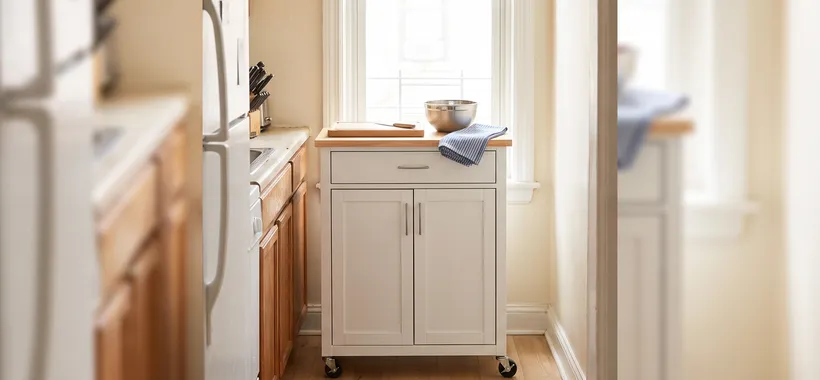
A small kitchen rarely has the floor for a built-in island, and most compact carts quietly fail at the test their photos hide: what your floor pays when nobody is cooking. The four rolling island carts compared below are judged on the footprint each one leaves behind when parked, whether the casters keep it planted while you work, and which storage actually earns its space.
There is no forced single winner. The VEVOR 23.2-inch cart is the pick when the parked slice is skinny and shallow, the Home Aesthetics bamboo cart runs a daily prep routine on drawers, the 35.4-inch VEVOR parks an appliance behind doors, and the MAHANCRIS folds its leaf and rolls out of the room until dinner. The measuring routine further down settles which one your own floor allows.

VEVOR Small Kitchen Island Cart with Cabinet and Drawer, 23.2-Inch Wide, White

Home Aesthetics Rolling Bamboo Kitchen Island Cart with Two Drawers and Locking Casters

VEVOR Kitchen Island Cart with Solid Wood Top, 35.4-Inch Width, Storage Cabinet, White

MAHANCRIS Kitchen Island Cart with Drop Leaf, Drawer, White and Natural KINW12501
How the four rolling island carts compare
Read the parked footprint first: it is the box your floor pays day and night, and it rules out more carts than any feature list. Casters, rated loads and the numbers behind each cell are in the product sections below.
| Cart | Parked footprint | Work top | Storage |
|---|---|---|---|
| VEVOR Small Kitchen Island Cart with Cabinet and Drawer, 23.2-Inch Wide, White | 23.2 in wide x 17.7 in deep, 35.8 in tall | Engineered wood | 1 drawer, cabinet with 2 shelves, towel rack, hooks |
| Home Aesthetics Rolling Bamboo Kitchen Island Cart with Two Drawers and Locking Casters | 21.5 in wide x 29 in deep, 35 in tall | Varnished bamboo | 2 drawers (per Home Aesthetics' description), 2 shelves, towel rack |
| VEVOR Kitchen Island Cart with Solid Wood Top, 35.4-Inch Wide, Storage Cabinet, White | 35.4 in wide x 17.7 in deep, 32.7 in tall | Solid rubberwood | 2 drawers, 4-door cabinet with adjustable shelves, spice rack, towel rack |
| MAHANCRIS Kitchen Island Cart with Drop Leaf, Drawer, White and Natural KINW12501 | 23.7 in wide x 15.8 in deep, 33.3 in tall (deployed) | Particleboard with metal frame | 1 drawer, 2-position shelf, towel-bar handle |
VEVOR Small Kitchen Island Cart with Cabinet and Drawer, 23.2-Inch Wide, White: the fit-first answer for a tight parked slice
For the kitchen whose only spare floor is a skinny slice beside the counter, this is the pick. The parked box measures 23.2 inches wide, 17.7 inches deep and 35.8 inches tall, the smallest parked footprint in this lineup, and at 37 pounds it is a one-person carry on delivery day and again on moving day. Nothing anchors the cart to a wall, so the floor it borrows comes back every time you roll it out of the walkway.
Two numbers decide before the shelves win you over: 23 inches across and 18 inches deep. If that much clear floor exists beside your counter, the cart fits, and the 35.8-inch top lands close to ordinary counter height, so daily cooking can spill onto it rather than onto whatever surface is free at the moment. Tape the slice out on the floor and walk a day with it.
Storage is modest and routed. One drawer holds the everyday kit: peelers, twist ties, the corkscrew that otherwise drifts along the counter. Behind the single door, two tiered shelves take the bulky low-frequency stuff, and the towel rack and hooks absorb the dish towel and mitts that would otherwise drape off the oven handle. The top stays working instead of becoming a landing shelf for clutter.
This is the smallest width in VEVOR's nine-label line of these carts, whose options run up to a 60-inch width label plus drop-leaf labels, none reviewed here.
The trade sits in the top and the drawer count. Engineered wood is a wipe-clean staging surface, sized for unloading groceries, cooling loaves out of the oven and standing the coffee station, and the maker's care instruction is hand wash only. It is not the surface anyone buys for twenty minutes of knife work. And a single drawer concentrates all of the small tools, which a cook who grabs three utensils a minute feels by the second dinner. VEVOR pitches this cart as its small-kitchen island, built to make a few spare inches of floor do an island's job, and that is the use it rewards.
Skip it when the job is a wide prep expanse or a solid chopping station. The reader that boundary turns away is the cook the bamboo cart below is sized for.
Home Aesthetics Rolling Bamboo Kitchen Island Cart with Two Drawers and Locking Casters: the prep-station pick for daily cooking
Prep-first kitchens get their cart here. Two drawers, per Home Aesthetics' own description, take the tools a chopping session needs within reach, and the varnished bamboo work surface measures 29 inches deep by 21.5 inches wide, standing 35 inches tall.
The number that rules most kitchens in or out is not width here, it is depth. 21.5 inches across is the narrow side of this lineup, but the cart asks 29 inches of depth at its parked spot and along its roll path, because a big flat surface is exactly why depth has to be there. An aisle that frees 22 inches across but not 29 deep rejects this cart whatever the shelf count holds.
Day to day, the structure works like a prep station should. Knives and boards live on top, utensils pull from the two drawers, and two shelves underneath take the overflow: the stand mixer's accessories, the bread bin, the tote bags that come home heavy. The top is rated to 110 lb, which is the honest ceiling for the mixing bowls and bowl stacks a cooking routine stages on it, and heavy gear still belongs on a lower shelf rather than the top edge. Home Aesthetics describes the bamboo as kiln-dried and varnished, and the maker's care instruction is hand wash only, so upkeep is a wet wipe and a dry, not a soaked sponge.
Two of the four casters lock. That is the honest lock story for this class. The locked pair carries the parked cart's stability, and the lean test further down settles whether it holds on your floor.
At 44 pounds it is a one-adult carry. A side rack takes the towels and aprons, keeping them off the drawer pulls.
Close call: against the 23.2-inch VEVOR, this cart wins on width (21.5 inches across, against 23.2) and gives up depth (29 inches asked, against 17.7). Which of those is your tight dimension is the whole decision between the two.
Skip it when free floor depth runs tighter than about 29 inches, or when the job is parking an appliance behind closed doors rather than cooking off the top.
VEVOR Kitchen Island Cart with Solid Wood Top, 35.4-Inch Wide, Storage Cabinet, White: pays for its width in cabinet parking
The reader with one permanent slot of floor and gear that needs hiding has found the right cart. It spends 35.4 inches of width and 17.7 inches of depth, stands 32.7 inches tall with the top 32.5 inches off the ground, and pays the floor back as two drawers, a four-door cabinet with shelves that re-space at 32 millimeter intervals, and a spice rack, towel rack and hooks on the working face. VEVOR describes the cabinet as a home for a microwave or toaster, and the parking mechanism behind that is plain: re-space the shelf against the thing you own.
The appliance check is a tape measure, not a promise. Set the case of whatever is meant to disappear, height and depth, against the cabinet interior after the shelf is adjusted to its lowest position, and the answer is settled before delivery day.
Doors are the part doing quiet work. Bulk rice, the bag of dog food, the tangle of appliance cords and the appliance itself all disappear behind four panels, and the top stays working because the visual clutter is inside the cabinet rather than on every open surface of the kitchen. The racks and hooks earn their footprint only when they displace something you would otherwise prop somewhere worse: a kitchen that already keeps spices at the wall never crosses the room for the spice rack. The frame is rated to 300 lb, so heavy loads sit low near the cabinet floor, and the solid rubberwood top takes the maker's wipe-with-dry-cloth instruction.
The trade is the frontage and the weight together. 35.4 inches of floor is rented full time, which makes this a permanent fixture in disguise rather than a cart that parks and leaves daily. On moving day the 66 pounds asks for two hands or two trips with the doors emptied. Skip it when the aisle slice is the only spare floor there is, because a galley that gives 35.4 inches to this frontage turns into a corridor, and the narrow VEVOR above rents less floor while holding less.
MAHANCRIS Kitchen Island Cart with Drop Leaf, Drawer, White and Natural KINW12501: for the daily fold, roll and park routine
The cook who needs the floor back by dinnertime should start here. Deployed, it measures 23.7 inches wide, 15.8 inches deep and 33.3 inches tall, the shallowest parked box in this lineup, and at 17.8 kg, about 39 pounds, it is the lightest carry here. The other three carts stand where they live. This one exists to leave the room daily: MAHANCRIS says the top folds away to save space when it is not in use.
The habit it wants is simple and repeatable. Fold the leaf, take the towel bar as the push handle, and roll the frame out of the cooking lane to a wall until dinner. One drawer holds the mid-prep tools, and an adjustable shelf with two positions takes the gear that comes off the top. Four wheels carry the frame, and two diagonal locking casters pin it at opposing corners while it stands, so the unlocked pair is the drift the lean test below checks.
The 110 lb rated static load is the ceiling, and on a particleboard top over a metal frame it settles what this surface can be. That is a staging-and-breakfast surface, never a bulk-load or appliance base, so the honest trade is the lightness and the daily exit at the cost of heavy parking. Care follows the maker's wipe-with-dry-cloth instruction.
On delivery day the kit is the island, an accessory kit and instructions, and assembly is required rather than arriving ready-made. Upstairs, around corners and through doorways, about 39 pounds is as close to a one-trip carry as this lineup gets.
Close call: against the 23.2-inch VEVOR, the parked width is a near match (23.7 inches against 23.2), and the difference sits underneath. The VEVOR parks storage behind a fixed top. This cart gives up the cabinet for a fold and a lighter everyday exit, so daily parkers buy one and set-and-stay kitchens buy the other.
Skip it when the job is bulk storage or a large appliance, which wants a door-closed cabinet rated for heavy loads instead of a folding strip.
Which measurements rule a cart out first?
Every number above answers to a tape measure in your kitchen, not the other way round, and three distances decide the fit in this order.
- The parked slice: the free floor beside the counter where the cart will actually stand, measured across and out. The cart's parked box has to sit inside it with all four corners clear, because a cart that fits nowhere parks nowhere.
- The roll path: the route from the parked slice to the cooking lane and back, including any threshold strip at a doorway. The narrowest point of the path is the width that decides, and a parked box that clears the doorway on the sales floor can still fail your hallway.
- The swing zone: the doors that open near the parked spot (dishwasher, fridge, oven) plus the lane a person needs to walk past while it stands there. A cart that fits the parked slice can still fail this one by clipping the dishwasher door every cycle.
Treat the parked footprint as the number you buy against. A deployed cart earns the floor it works on, but the parked one is what your kitchen pays day and night, so the honest test is the cheapest one: tape the parked footprint on the floor, leave it for an evening, and walk a normal day past it. If midnight, the dishwasher door or the dog bed has to negotiate, the slice is too small.
Will it stay planted while you work?
Every cart above rides wheels, so the part worth trusting first is the lock, not the roll. The bamboo cart locks two of its four casters, the MAHANCRIS locks two at opposing corners, and on the two VEVOR carts the lockable-caster wording is the maker's, which is why the behavior needs a lean test rather than a promise.
The test costs nothing: park the cart where it will live, lock every caster that has a lock, press the top sideways with about the force you would use to shift a cutting board into place, and watch the wheels. If a wheel creeps, if the frame racks, or if the locked pair lets the cart walk, think again before anything heavy sits on it.
Floors change the answer underneath the same wheels. Tile seams and threshold strips wear on caster mounts over time, hardwood and loose rugs favor softer treads, and carpet can turn any one of these carts into dead furniture. Roll the actual path once before committing, because the same cart that glided across a showroom can stutter on a threshold strip in your hallway.
The ratings read plainly: the narrow VEVOR is rated to 130 lb, the bamboo cart to 110 lb, the wide cabinet cart to 300 lb, and the MAHANCRIS to 110 lb as a static load. Those numbers are ceilings, not results, so they are worth one glance before a stand mixer or a stack of cast iron migrates onto any of them.
What each work top asks of you
The four tops are four maintenance contracts. The narrow VEVOR's engineered wood and the bamboo cart's varnished bamboo come with hand-wash-only instructions from their makers, the wide cabinet cart's solid rubberwood wipes down with a dry cloth, and the MAHANCRIS's particleboard over its metal frame takes the same dry-cloth treatment. Whatever the top, the chopping happens on a board set on it, the ordinary habit that keeps any wood-family surface working.
Care comes in two kinds. The two hand-wash-only tops want spills wiped and dried rather than a soaked sponge or a run under the tap, which matters on the evening the top doubles as the prep overflow. The dry-cloth tops ask for the least: crumbs and smears off with a dry cloth, not a scrub-down.
Height closes the decision, and it is always against your own counter rather than any rule: 35.8 inches on the narrow VEVOR, 35 on the bamboo cart, 32.7 on the wide cabinet cart and 33.3 deployed on the MAHANCRIS. A top that lands near your counter turns the cart into prep overflow, a second workspace where a mixing bowl and the morning's cutting can rest without rearranging the kitchen. A top noticeably lower still earns its parking spot as a landing shelf and a staging strip, but long chopping sessions notice the difference.
Where it parks, what it holds, and moving day
Walking the kitchen at your own pace settles the rest. The floor nobody claims yet includes the strip between fridge and counter, the nub at the end of a galley, the gap beside the trash can. The things that must move when the cart rolls out include the hamper, the dog bed, the recycling bin itself, the path to the bathroom at midnight. If the move is a wrestling match every evening, the cart is renting floor your night never gets back, whatever its features promise.
Load balance is the one habit that gets the most out of every rating in this roundup. Heavy things sit low, near the cabinet floor or the lower shelf, and light things ride the top, because a top-heavy cart on casters is a tipping cart.
Weights are the moving-day side of the deal, and the lineup runs 37, 44, 66 and about 39 pounds. A 39-pound cart climbs a stairwell alone. The 66-pound one usually waits for a neighbor's hands, and that is the whole moving-day difference. The brief version of the parked kitchen check:
- Does the cart clear the dishwasher door's swing when it stands beside it?
- Does the walkway past it stay usable at midnight, dog bed included?
- Does the roll path clear the hamper, the trash can and the recycling bin?
- Does the top take the daily kit while the bulk sits low behind doors?
Park the cart behind those four answers and it starts paying rent from the first evening.
When a slim rolling pantry tower is the better buy
Same wheels, different promise. A rolling pantry tower solves "where do the canned goods go": vertical storage in a narrow slot, wheels to move the stack around. A kitchen island cart solves a different problem: "where do I put the board, the gear and the appliance I actually use". Choosing between them is one sentence, not a comparison.
If your kitchen already has the work surface it needs, and your real problem is that food and gear pile up on the floor, the storage-only answer wins, and the slim rolling pantry tower is where that decision lives. If the counter is crowded from breakfast onward and prep happens wherever there is room, the cart is the buy that earns the floor it takes. The test that matters is whether you ever actually cut, mix or plate on the thing.
Last questions before checkout
Do the casters lock on all four wheels?
Two of four lock on the bamboo cart, and the MAHANCRIS locks two at opposing corners. The two VEVOR carts carry the maker's lockable-caster wording, and the lean test above is the check that settles what the wheels actually do under a real push.
Will the cabinet on the wide VEVOR hold an appliance?
The cabinet is made for exactly that parking job: the shelves inside re-space at 32 millimeter intervals to sit around what you own. Set the appliance case's outer height and depth against the re-spaced interior before delivery day, and the answer comes from your kitchen rather than from a claim.
How heavy is each cart to move?
37 pounds for the narrow VEVOR, 44 for the bamboo cart, 66 for the wide cabinet model, and about 39 for the drop-leaf MAHANCRIS. The lightest is a solo carry upstairs, the heaviest asks for two hands or two trips.
Do these tops land at counter height?
Between 32.7 and 35.8 inches depending on the model, so the comparison is against your own counter. A top near counter height makes the cart prep overflow, and a top noticeably lower still works as a landing shelf, though long chopping sessions notice the difference.