
Best Magnetic Modular Storage for Small Space Living
Last updated By Maya Bennett How we chooseAffiliate disclosure
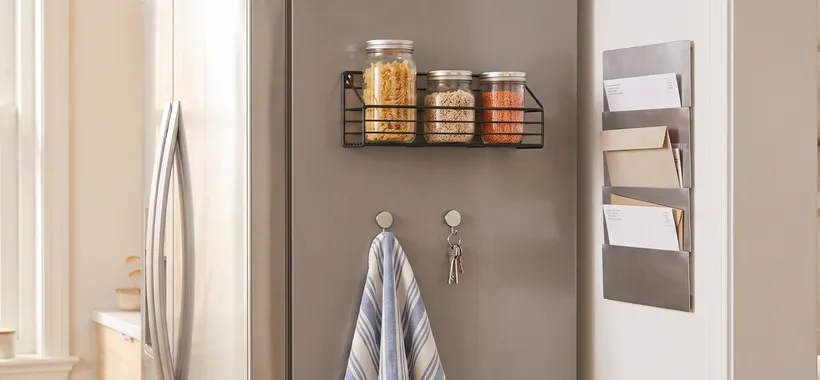
Magnetic modular storage is one of the highest-leverage moves for a small home: a narrow wall strip, a fridge side, or the flank of a steel cabinet becomes shelves, pockets, and hooks with no drill holes, no floor budget spent, and nothing taken from the deposit. But the whole class runs on one condition. The surface has to be ferrous metal, and a two-minute test settles that before you compare anything. Stick a plain refrigerator magnet on the exact spot you have in mind.
If it barely grips, or slides down under its own weight, nothing in this review will hold on that surface and the honest decision is to stop there.
The metal question is less predictable than it looks. Some stainless fridge doors accept magnets and some ignore them, because the alloy inside the door decides, and a coated finish can interfere on its own. Once the surface passes, the zone picks the style. Produce and spice overflow wants a lidded magnetic shelf on the fridge side. The papers that colonize counters and desks want vertical pockets. An entryway with no metal at all wants a steel panel you mount once, and then magnets work there. Real gear wants lever-release hooks. The everyday hangs want small hooks that move whenever the routine changes.
Below I compare five organizers across those jobs, and the table lets you shortlist by zone in one pass. After the lineup comes the part most listings skip: what a weight rating actually holds on a vertical, probably painted, possibly thin door, plus a short measure-first checklist that catches the wrong order before it ships.
Matching the organizer to your zone
| Organizer | Zone | Mounting | Best for | Catch |
|---|---|---|---|---|
| Ofiray-home Magnetic Fridge Shelf with Wood Lid | Kitchen and pantry | Magnets, no tools | Produce and spices, plus a lid that works as a landing shelf | Size is not listed anywhere, so measure the clearance first |
| 6-Tier Magnetic File Holder, Black | Paper and office | Magnets, no tools | Files, mail, and papers in visible pockets | Needs a tall, flat metal surface and stores shallow items only |
| Yamazaki Tower Magnetic Wall Panel with Hooks and Shelf | Entryway | Pins or screws (both included) | Keys, mail, leashes, and a note face | You mount it once with a tap or drill, and you supply the magnets |
| Gator Magnetics MIDI 4 in Red Open Hooks, 3 Pack | Hanging, heavy gear | Magnets with a lever release | Tools, cords, and real gear on thin steel | Grip varies with the surface, and aluminum or some stainless will not work |
| MIKEDE Magnetic Hooks, 10 Pack | Hanging, everyday light | Magnets, screw-on hooks | Towels, utensils, string lights, cruise gear | The headline rating only applies to vertical pulls |
Ofiray-home Magnetic Shelf

For most readers whose surface passes the magnet test, this is the pick. The side of the fridge is the one big, flat metal surface nearly every small home already owns, and the Ofiray-home Magnetic Fridge Shelf with Wood Lid turns it into pantry space without asking the floor for a square foot of anything. It is the lineup's only lidded, top-loading bin, a see-through container sized for potatoes, onions, or spice jars, topped by a wood lid that doubles as a small landing surface. One owner praises the rail along the lid's top edge that keeps a phone or an oil bottle set on it from sliding off, and that rail is what turns the lid from a cover into a surface that earns the counter space it replaced.
Assembly is the smallest part of the decision. One owner put theirs together in about ten minutes with no tools, and another says all you have to do is put it where you want it, so the real work is placement. Slide the shelf onto the fridge side, load the bin, and the whole arrangement relocates whenever the produce rotation changes, coming down as easily as it went up. The listing claims it supports up to 15 kg, about 33 lb, which is generous headroom for a bin of vegetables. What your particular door holds is a question the box does not answer, and the shared guidance below handles that translation.
The gap you need to respect is size. The listing publishes no dimensions for this unit, so the bin's footprint and depth are unknown, and that unknown is exactly what a small kitchen should not learn by eye, because a bin deeper than the counter next to it can end up in a cabinet door's swing path, or where the fridge door's own travel clips it. One owner mounted theirs above a fridge door that hinges at the bottom, reports the head-bump risk, and recommends the side panel instead. Your tape measure carries that check, and the checklist below makes it concrete.
Skip this shelf if your fridge has narrow doors with no free side, if the space over your fridge door would sit above your head at the counter, or if your surface failed the magnet test. If all you want is hanging points for utensils and towels rather than storage volume, the MIKEDE hooks below cover that job without the footprint, and a surface that fails the test needs no organizer at all.
6-Tier Magnetic File Holder, Black: Paper and Mail Off the Counter

If the paper pile has annexed a counter or a desk, this is the pick, and nothing else in the lineup competes for the job. It is a vertical run of pockets that hangs on magnets, five file pockets for folders, mail, and notebooks plus a smaller compartment for pens and sticky notes, all open-fronted so you can see what each pocket holds without unloading it. The "6-Tier" name is the listing's own, and the structure behind it is five file pockets plus that one extras compartment.
Its dimensions are the most fully documented in this lineup, and they are the ones that should make the decision. The body runs 12.6 inches wide, 15.9 inches tall, and 4.2 inches deep, with a magnet face of 12 x 6.3 inches. Translated into the room, 4.2 inches of projection keeps a walkway usable, the height needs 15.9 inches of genuinely vertical room on the surface, and the magnets need a flat patch of metal at least 12 x 6.3 inches to land on, which the listing itself tells buyers to measure first.
The listing claims a capacity of 22 pounds, and owners loading papers and binders onto a file cabinet report it staying put. Keep loads distributed and modest anyway, and treat the figure as the seller's number rather than a dare. One buyer-reported detail also decides placement. The magnets grip hard enough that one owner reports moving a loaded run by sliding it toward the edge of the surface rather than lifting it off, so decide where it belongs before it is full. And the paper stays visible all day. If you want your storage to hide its contents, this is the wrong style, while if you treat mail as a visible to-do shelf, the visibility is the feature.
Skip it for anything bulky or deep, since the pockets are shallow by design and the listed jobs are files, mail, papers, pens, and notes. Skip it on textured, painted, or non-iron surfaces for the reason the shared guidance explains. If your clutter is small items rather than paper, the hooks or the Yamazaki panel's shelf will do more for you than a file holder will.
Yamazaki Magnetic Wall Panel

If your wall is not metal and you can pin or screw one thing to it, the Yamazaki Tower Magnetic Wall Panel is your route. It is a strip of steel 27.6 inches wide, 5.9 inches tall, and 0.6 inches deep that mounts with the included pins or wood screws, and once it is on the wall, magnets work on its face. That makes it the lineup's bridge route for readers with no magnetic surface at all, and it brings a memo face, sliding hooks, and a shallow shelf along in one band.
The face is the communication half. Pin notes, reminders, or a receipt you must not lose with your own magnets, since the magnets that hold anything to the panel come from your supplies, not from the box. Owners report magnets grabbing the panel well, kitchen timers and remote controls among them. The hooks slide freely along the lower edge, so their positions move as your routine does, and the shelf up top holds a phone, the day's outgoing mail, or whatever walks in flat.
Mounting is the trade that pays for that capability. It asks a tap or a drill, and two owners describe leveling the brackets as finicky, one of them resorting to the paper template the box includes for placing the holes. What the trade buys is a stable, deliberate home for the entry-zone job that loose hooks would scatter: keys, mail, a leash, and whatever the face carries, all in one fixed place. Decide before checkout whether that permanence suits your entryway, and whether your drilling permission covers it.
The hooks are light-duty, and light loads keep them sound: keys, leashes, a small tool, mittens in season. The listing rates the panel at 4.4 lb, which is plenty for a keys-and-leash class of load and rules out anything gear-like. Skip the panel if you cannot or will not drill anything, since a pure magnetic mount on a metal surface is the better fit there. And on a surface that is already metal and magnetic, the MIKEDE or Gator hooks cover hanging without any wall work, so the panel earns its keep specifically where magnets otherwise fail.
Gator Magnetics MIDI Hooks

When the hang is real gear on thin appliance steel, this is the hook to choose, because it is the only one in the lineup designed for the mode that defeats ordinary cup magnets: shear on thin sheet metal. The Gator Magnetics MIDI hooks pair a patented lever release with an open hook. Flip the lever up and the magnet lets go of the surface so the hook can move. Flip it down and it grips again. That one-hand release is a genuine difference in daily use, where a plain cup magnet with real grip takes two hands and some wiggling to relocate.
The listing rates each hook at 25 lb. The maker also says the design delivers shear strength on thin steel. What the listing documents plainly is the surface list: toolboxes, steel cabinets, workbenches, utility vans, lockers, and appliances.
Owners put these hooks to work on shovels, rakes, and extension cords hanging from 18-gauge metal cabinets and shop walls, real loads on thin steel. How much the same hook holds, though, varies with the surface and the load direction, a split the shared section below takes up honestly. What the design contributes is that one-hand release and an open hook, which takes wet jackets, cords, and odd shapes better than a straight cup arm ever will.
Skip these hooks on aluminum, some stainless steel, or surfaces with heavy texture in the coating, all documented mismatches where no rating number changes the physics. Skip them for small light hangs too, since the maker's engineering does not help a potholder and the MIKEDE hooks below cover that class. Owners also describe these hooks as pricier than ordinary magnetic hooks, which is worth knowing when the job is plain thick-steel work with light loads. And when a hang will genuinely never move again and holding matters more than reversibility, a screw-in utility hook is the permanent route instead.
MIKEDE Magnetic Hooks

Some hooks buy you one strong point. This one buys adaptability, which is why it earns the light-duty role in the lineup. The MIKEDE Magnetic Hooks are small cup magnets with screw-on hooks, and the listing's images show a 10-pack. The hooks ship unattached, you screw each one into its magnet base in seconds, and from there every hook is a hanging point to stick on, move, or remove whenever the routine changes. Owners describe them as tiny, roughly pinky-sized, and easy to reposition, which is the honest shape of the value here, a changeable set of hooks rather than one anchored fixture.
The everyday hangs are the job list: wet towels by the sink, pot holders near the stove, keys by the door, a string of lights, and jackets hanging near cruise-cabin walls. The listing also states what the contact surface needs, and it is worth reading: iron in the surface, smooth, dry, and free of oil. A painted door that just barely holds the magnet can still let it drift once moisture or grease gets between the faces, so a quick wipe before mounting is a cheaper experiment than diagnosing a dropped towel later.
One owner reports a pair of BBQ tongs slipping off a single hook and needing two together, which is the owner-side version of the load question on these hooks. The listing's headline rating describes ideal vertical pull, not what a horizontal load experiences, and that distinction is the doorway to the shared section below. Some heavier tools ask for a pair of these hooks, and some surfaces ask you to test one before trusting it.
Skip them for tools and actual gear, which is the Gator hooks' role. Skip them on textured paint or plastic, since neither surface has the iron content the magnet is asking for. And if the surface fails the plain-magnet test, no hook pack fixes it, for the same reason it does not fix the shelves. Whatever surface is missing, the hook cannot supply it.
What a weight rating actually holds on a vertical door
Most readers meet their first weight rating in the worst possible context: a vertical door, a coated finish, and a load that hangs sideways. A manufacturer's rating is a breakaway force, measured by pulling the magnet straight out, perpendicular to thick, bare, clean steel. The number is honest, and it describes contact conditions that few kitchens or hallways offer.
A rating is a lab maximum. Your door decides the rest.
Gravity pulls the load down the surface rather than away from it, so what resists is friction between the magnet's face and the door. For smooth, nickel-plated magnets on smooth steel, that sideways holding runs roughly 15 to 30 percent of the rated pull before the whole arrangement starts creeping downward. Coatings cut holding further, because paint and finish create an air gap between the magnet and the steel beneath. Thin appliance-gauge sheet metal delivers only a fraction of the rating no matter how strong the magnet claims to be, because thin steel cannot carry the full magnetic field. The arithmetic behind these fractions is published in detail by magnet suppliers, and the Radial Magnets pull-force guide is a readable walkthrough of the pull-versus-shear distinction.
The MIKEDE listing above states this trade openly, which is rare and useful. It claims more than 85 lb of attraction force on vertical application, and its own text notes the power drops by two thirds when the hook hangs anything horizontally. Two thirds, stated by the listing itself, before your door's coating or thickness has its say. The pattern worth checking in any listing in this class is a headline number with its conditions printed beside it.
Two fixes work better than a bigger number. The first is geometry: a shelf, ledge, or hook that lets the load rest inside the organizer rather than hang entirely from friction converts the sideways drag into a push the magnet bears straight against, which holds substantially better on a vertical surface than a bare cup magnet of the same rating. The second is handling: lift a loaded bin straight away from the surface rather than tipping or peeling it from one edge, because peeling concentrates detachment along a thin line that fails at less force than a straight pull. Rubber-faced or friction-padded magnet designs also hold better in shear than bare polished cups, so that is a feature worth looking for when one shows up on a future purchase.
Real ownership splits on the same question. Two owners of the Gator MIDI hooks report poor holds on their gear, while several owners report the same model holding shovels, rakes, and extension cords on 18-gauge metal cabinets and shop walls. Both reports can be true, since different surfaces and different load directions give the same hook different jobs. The honest conclusion is not a consensus verdict in either direction. Surface and load direction decide, and testing with a light item first is the fastest way to learn which side of the split your door falls on. Keep fragile, heavy, or cast-iron loads off an untested magnetic mount, and keep nothing loaded where a slide would drop it onto a foot or a counter. And if the surface itself failed the plain-magnet test, magnets are the wrong tool for that wall, and the routes from there are the Yamazaki panel route above, when permission and mounting allow, or leaving the magnetic class for other renter-safe storage. No hook strength or clever orientation changes that.
Measure before you order
Two minutes with a tape measure separates a working setup from a return box. Work the list top to bottom, because earlier steps disqualify faster.
Stick a plain fridge magnet on the exact spot. Not the appliance across the room, the spot. If a plain magnet barely grips or slides, that surface rules out every magnetic organizer in this review.
Measure the flat metal area against the magnet face that needs to land there. Curves, trim, badges, and handles all consume flat metal, and the file holder's face needs 12 x 6.3 inches of it, so measure the patch, not the door.
Check projection and swing in both directions. Will the fridge door still close past whatever sticks out? Will a neighboring cabinet door clip a deep bin on its way open? Does the walkway keep its width with the organizer loaded and a person passing?
Match the footprint to the load and reach. What goes in and out daily, and at what height? A shelf that carries the lunchbox in theory but sits above a comfortable reach in practice becomes a step-stool errand within the week.
Tape the footprint on the floor or wall and live with it for a day. What already uses that strip is what has to move: the light switch, the doorframe trim, the outlet, the recycling bin. If nothing has to move, the footprint has passed its test.
Surface and setup questions
Will these stick to my stainless steel fridge?
Some do and some largely do not, and the difference is the alloy inside the door rather than the brushed finish you can see. Many stainless fridges use grades that magnets barely notice, while others grip normally, and the coating on some finishes can interfere too. Your test magnet decides the case, since the door will not show you which grade it carries. Whirlpool's own guidance on magnets and stainless appliances explains the grades plainly if you want the background behind the test.
Do magnets scratch a fridge door?
They can, when the face is sharp-cornered or textured. Flat-faced magnets sit flush against the door and are gentler, and on an appliance you face every day that difference is worth shopping by. Scratching is a possibility rather than an inevitability, and the cheap defenses are the ones this guide already leans on: flat contact, a clean surface, and a test before any load goes on.
Can I rearrange everything once it's up?
The pure magnetic picks here lift off and relocate freely with no tools, whenever the routine changes. The Yamazaki panel is the deliberate exception. Its hooks slide along the edge whenever you like, but the panel itself mounts once with pins or screws and stays put, so place it deliberately before loading it. The file holder sits between those two, since a loaded run of these pockets moves by sliding toward the edge of the surface rather than lifting.
My wall isn't metal. Can I still use any of this?
Only through the panel route above, mounting the steel panel with a pin or a drill so magnets then work on its face. Before deciding the wall is the only option, run the test magnet along the kitchen's appliances, the file cabinet, or the radiator cover, and see what surfaces you already own, because a lot of homes have more ferrous metal than they advertise.
Guides that use these ideas

Maximize a 3-Foot Closet: Vertical Storage for Brooms, Vacuums & Supplies
Free floor space and tame clutter in a 3-foot closet with vertical hooks, slim racks, caddies and DIY mounts to neatly store brooms, vacuums and supplies.
Read more
Foldaway Craft Zone: Maximize Workspace & Storage in a 100 sq ft Studio
Turn your 100 sq ft studio into a foldaway craft zone: learn smart layouts, fold-down furniture, hidden storage hacks, and budget DIY tips to maximize room.
Read moreMicro-Storage ROI: Maximize Value Beyond Square Footage
Learn to price, design, and manage micro-storage for studios, apartments, camper vans. Find cost and ROI strategies plus honest tradeoffs to avoid wasted space.
Read more
Under-Stair Conversions: Laundry, Pantry & Compact Office Plans
Turn wasted stair voids into usable utilities - laundry, pantry or compact office. Get layout plans, venting tips, storage solutions and budget DIY options.
Read more