
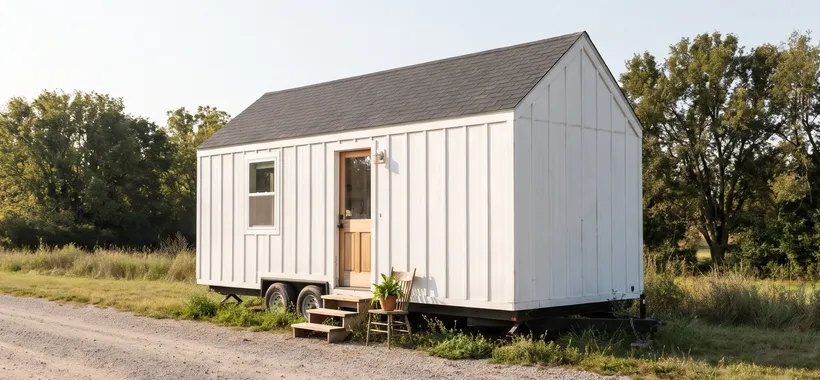
The tiny house movement started in the late 1990s, when Jay Shafer began building a very small house on wheels and went on to found the Tumbleweed Tiny House Company in 1999. It did not begin with television. The TV shows arrived in 2014 and amplified a movement that had already been organizing for roughly fifteen years, with roots in small-house books reaching back to the early 1970s. And living very small is far older than any of that.
Living small used to be something that happened to people. Tenements, boarding houses, shotgun houses, trailers and houseboats answered housing pressure for people with little money or little permanence. Choosing a very small home on purpose, when bigger options exist, is the modern movement's real novelty. This piece traces that line from necessity to choice, through the housing crash and the TV boom, to today's zoning fights, and ends with the questions the history hands anyone considering small living now.
Key takeaways
- Living very small is old. Choosing it is new: tenements, trailers and houseboats were tiny by necessity, the modern movement is tiny by choice.
- Jay Shafer began building a tiny house on wheels in 1997, finished The Small House Book by 1999, and founded Tumbleweed that year.
- Television amplified the movement in 2014, but tiny homes stayed roughly 1 percent of home purchases even during the boom.
- Tiny home villages grew from 34 in 2019 to 123 by summer 2024, and the movement looks normalized, not vanished.
- Every era hit the same wall: rules written for other dwellings. Check local zoning, minimums and parking rules before committing.
What did living very small look like before anyone called it a movement?
Start with the cities. Tenements and boarding houses packed workers into the neighborhoods near their jobs, and the constraint was built into the architecture: toilets shared down the hall or in the yard, walls thin enough that a neighbor's alarm became your alarm. The smallness served the rent-per-room math of the building's owner, not the preferences of the people in it.
Shotgun houses ran the same logic in a different shape. One room wide, rooms strung front to back, home to blue-collar families across Southern cities from the late 1800s through the Depression. No hallway means no privacy, and the layout works best where the doors can stand open.
Then come the dwellings that sat outside the housing system entirely: house trailers, houseboats and vans. These housed people with little money or little permanence, and their defining constraint was legal rather than architectural. A home that can be towed can also be told to move. Nothing about a trailer, a boat or a van necessarily came with a lease, a utility account or a place in the housing code, and the same mobility that freed you could evict you.
Thoreau's cabin at Walden Pond gets invoked here a lot, and it earns one sentence: it stands for tiny-by-choice thinking, a deliberate experiment, long before anyone called small living a movement.
Name the distinction plainly, because the rest of this story runs on it. The tenements, shotgun houses, trailers and houseboats above were tiny by necessity, answering pressure from wages, landlords and the law. The modern movement's novelty is tiny by choice, deliberately picking a very small home for cost, freedom or simplicity when larger options existed. Thoreau had chosen it too, but he was an exception that stayed rare. What changed by the late twentieth century was that the choice became a movement.
The smallness was never new. Choosing it was.
How did tiny-by-choice become an actual movement?
The idea had a paper trail before it had a builder. Lloyd Kahn's Shelter arrived in 1973, Lester Walker's Tiny Houses in 1987, and Sarah Susanka's The Not So Big House in 1997, each part of a running argument against the direction American homes were headed. Through the 1970s, artists and architects were also treating compact living as a subject worth investigating in its own right.
Jay Shafer turned the idea into a movement. His own account is plain about the sequence: in 1997 he began building a very small house on wheels, by the summer of 1999 both the house and The Small House Book were finished, and that same year he founded the Tumbleweed Tiny House Company. The house was roughly 90 square feet. The standard overview of the movement credits him with building the first modern tiny home, which is worth reading as credit rather than measurement. Other people had lived small before, and some had built small on purpose. What Shafer did was make it repeatable, sellable and talkable.
In 2002 he joined Greg Johnson, Shay Salomon and Nigel Valdez in founding the Small House Society. The organizing matured from there: a Tiny House Fair in 2013, an American Tiny House Association in 2015. That is the trajectory of a movement rather than a stunt. Books, then a house and a company, then an organization.
What did the housing crash and television actually do?
Two accelerants hit within a few years of each other, and they did different jobs.
The Great Recession of 2007 to 2009 changed the economics. When owning a conventional house stops looking like a safe bet and the heating bill keeps arriving, a home that is cheap to buy and cheap to heat starts making sense to people who would not have given it a second look. Interest in tiny houses appeared to gain momentum through those years.
Television changed the visibility. Tiny House Nation premiered in 2014, with Tiny House Hunters airing in the same era, and for a stretch the tiny house was a fixture of TV schedules and social feeds. Neither show invented anything. The movement they filmed had been organizing for over a decade before either network greenlit an episode.
The check on all that attention is what people actually bought. Even during the boom years, tiny houses stayed roughly 1 percent of home purchases, and the average size of newly built American homes kept growing rather than shrinking. The boom was real, but it was a media phenomenon more than a housing trend. If it felt like everyone was talking about tiny houses in 2015, you were right, and if you never actually met anyone who lived in one, you were probably right about that too.
Why has legality always been the constraint?
Every era of small living has hit the same wall: rules written for other dwellings. The pattern is older than the movement, and it is the part of this history that reaches into your own decisions, so it is worth being precise about how the wall works.
Zoning codes often specify a minimum square footage for new construction on a foundation. That single number can rule out a small floor plan before anything else about it gets compared. For a tiny house on wheels, the rules tend to treat it as a recreational vehicle, and parking on your own land can be prohibited by local regulations against camping. That is the lived consequence. You can own the home outright and still have nowhere the law lets you live in it.
The loosening is recent and local. Spur, Texas declared itself the first tiny-house friendly town in 2014, with a clarification that matters: the welcome applied to tiny houses secured to foundations, not on wheels. In 2016, Fresno, California became the first US municipality, as reported at the time, to write tiny homes into its development code. And in 2018, the International Residential Code added Appendix Q, which defines a tiny house as a dwelling of 400 square feet or less in floor area, excluding lofts. Appendix Q is a model code, not automatically local law, so whether it governs where you live depends on whether your state or city adopted it.
So the wall is movable, but it moves town by town. Spur is the pattern in miniature: even a town that rolled out the welcome mat kept part of it reserved for houses that look like the houses the rules were written for.
Is the tiny house movement over, or has it just stopped being a spectacle?
Two readings of the same present, and both have evidence.
The faded-boom reading: the TV cycle moved on, the feeds moved on, and tiny homes remain a niche market by any measure of actual purchases. Judged against the years when tiny houses were regulars on television, the movement has gone quiet.
The normalization reading: the quiet is what settling in looks like. Tiny home villages, counted in philanthropy reporting as one specific category, grew from 34 in 2019 to 123 by the summer of 2024. ADU reforms and Appendix Q-style code adoption keep bringing small dwellings inside the legal system instead of leaving them outside it, and tiny houses are increasingly used as accessory dwelling units for aging relatives, returning adult children, offices and guest houses. The last two of those are directional observations rather than measured shares.
One counter-current cuts against nostalgia in both directions. Tiny houses have themselves become larger, heavier and more expensive over time, drifting from the movement's founding aims.
My read of the signals is normalization rather than disappearance. The spectacle ended, but the infrastructure that lets a small dwelling exist legally stayed and grew. That is a way to judge what you see, not a forecast. If you want to know whether the movement is over where you live, the signal to watch is not television. It is whether your local rules have started to admit that a small dwelling is a dwelling.
What does this history tell you to check before you choose to live small?
The most useful thing this history offers is a list of failures it already ran for you. Each one maps onto a question you can check before committing to anything.
Is it legal where you would live? This is the oldest constraint in the story, and it is still the first question. What is the local zoning minimum, where can a tiny home legally sit or park, and do the rules treat a home on wheels as housing or as a vehicle? None of these have universal answers, and the town next door can run on different rules than yours.
What did past eras get wrong that you can check in advance? Tenements failed on sanitation and overcrowding. You will not repeat those exact failures, but the modern version of the same test is lived fit: where storage actually goes, whether two people can pass each other in the hallway, where guests sit, and how far the walk from the bed to the bathroom is at 2 a.m. The other underestimation, legal precariousness, is the first question above.
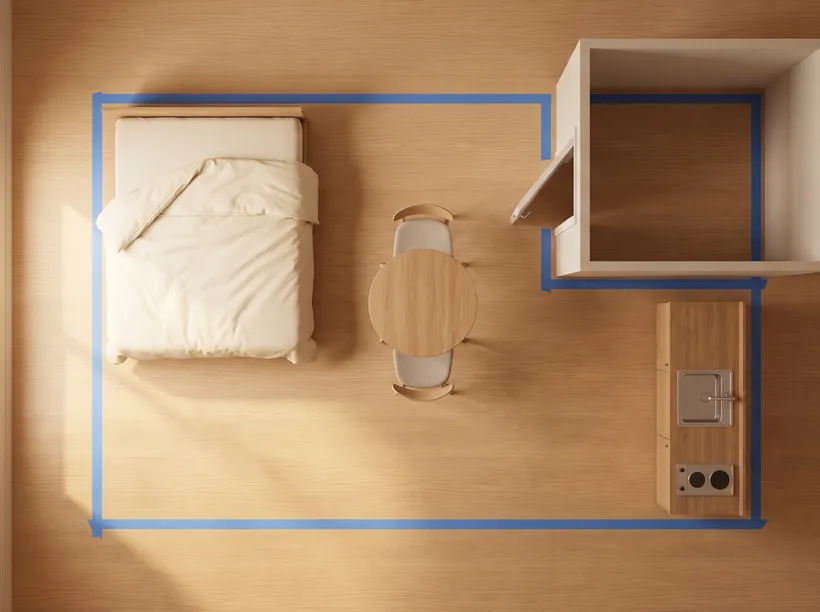
Where is the gap between the aesthetic ideal and the lived constraint? The images that built this movement's audience show tidy, sunlit rooms with nothing in them. Your home will contain your actual life. Tape the footprint out on the floor and live with the outline for a day, including noticing what has to move for the walkway to work, before you decide anything.
The history does not argue for or against living small. Tenements and trailers were small because the alternatives were worse. The modern movement is small on purpose, and the questions above are how you find out whether that choice works in your room, your town and your life.